General Practice and Primary Care
Promoting excellence in general practice and primary care through innovative research and effective links with the general practice community and the wider health care system.

Welcome to the Department of General Practice and Primary Care
Professor Lena Sanci, Head of Department
General Practice and Primary Care began as a unit within the Department of Community Medicine in 1977 and in 2001 was established as a separate clinical department within the School of Medicine; Faculty of Medicine, Dentistry and Health Sciences.
Vision
To promote excellence in general practice care through research and effective links with the general practice community and wider health care system.


About Department of General Practice and Primary Care
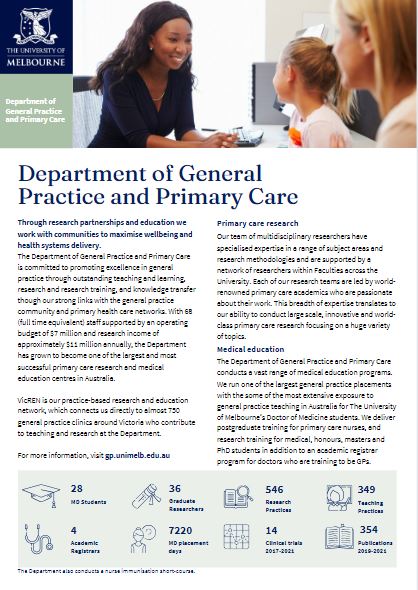
The Department of General Practice and Primary Care is committed to promoting excellence in general practice through outstanding teaching and learning, research and research training, and knowledge transfer though our strong links with the general practice community and primary health care networks.
Our Podcasts & Webinars
Explore the Department's suite of webinars and podcasts


Diversity and Inclusion
The Melbourne Medical School is proud to foster a vibrant and inclusive culture delivering initiatives that value and support diversity.
-
Our Podcasts & Webinars
Explore the Department of General Practice and Primary Care suite of webinars and podcasts
-
Departmental Seminars
Department of General Practice and Primary Care runs a weekly seminar series, every Wednesday, 1.00-2.00pm.
-
Newsletters
Newsletters from the Department of General Practice and Primary Care
The University of Melbourne is a globally engaged, comprehensive, research-intensive university uniquely positioned to respond to the major social, economic and environmental challenges of our time.
-
Clinical Trials Unit
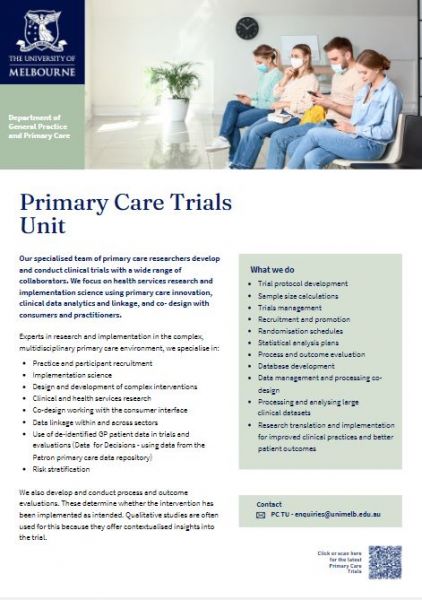
The Primary Care Research Clinical Trials Unit supports the development, conduct and analysis of high quality trials in primary health care and health services
-
Community Involvement
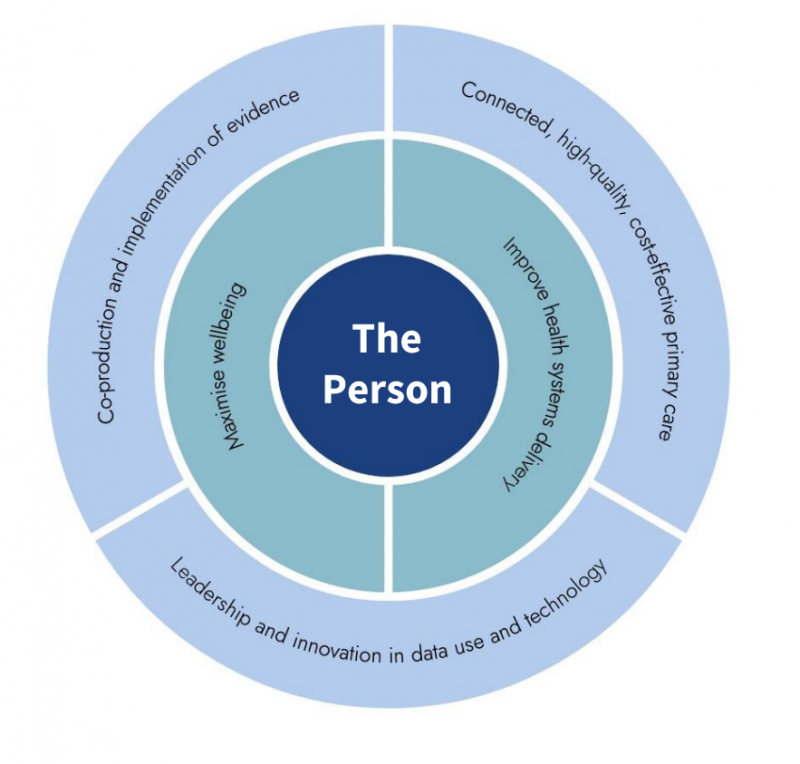
We work with communities and practitioners to improve the health care system, placing the person at the heart of healthcare and improving health outcomes
-
Data for Decisions
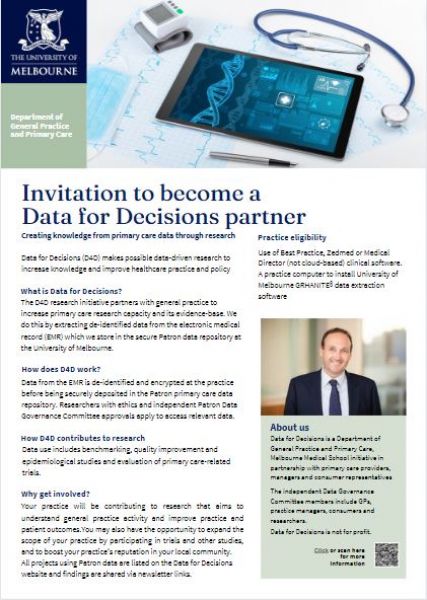
Data for Decisions, incorporating the Patron program of research, is a University of Melbourne, Department of General Practice and Primary Care research initiative in partnership with general practices in Australia.
-
Research Groups
An overview of the research interests within the department and the project work being carried out by our research groups.
Graduate Research at MDHS
A resource for students and supervisors seeking up to date information about policies and procedures
Whether you're just starting out or a seasoned professional, we have something to suit your needs and schedule. With the highest teaching evaluations in the Faculty of Medicine, Dentistry and Health Sciences we are proud to offer our coursework and short course programs to our leaders and future leaders.

Introducing a pathway to professional excellence with RACGP CPD
The Department of General Practice and Primary care is endorsed by the Royal Australian College of General Practitioners (RACGP) to be your Continuing Professional Development (CPD) partner. Explore our range of available programs and benefit from our seamless integration of CPD into your daily work. Accruing CPD has never been easier. Embrace a fresh take on CPD in 2023 and enrol today.
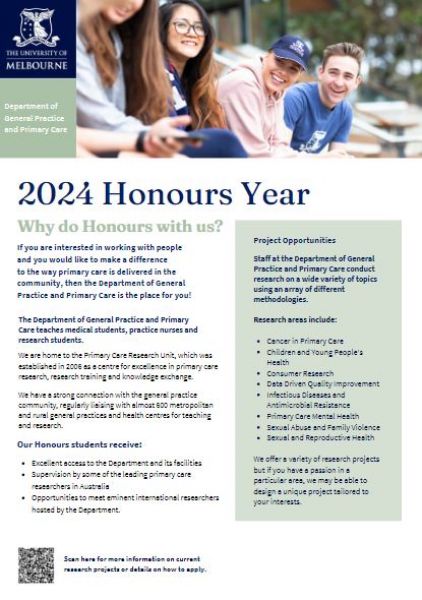
Honours
If you are interested in working with people and you would like to make a difference to the way primary care is delivered in the community, then this is the place for you!


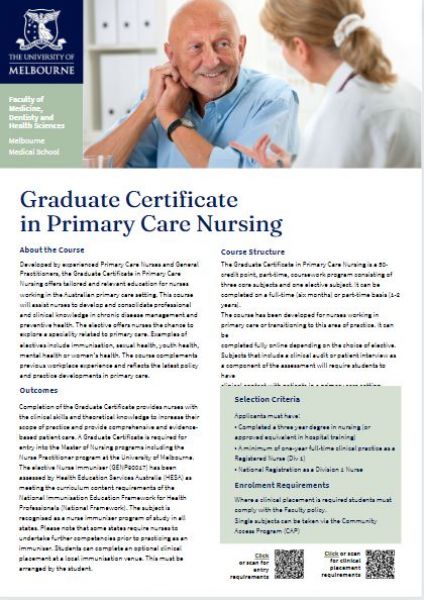
Nurse Immuniser
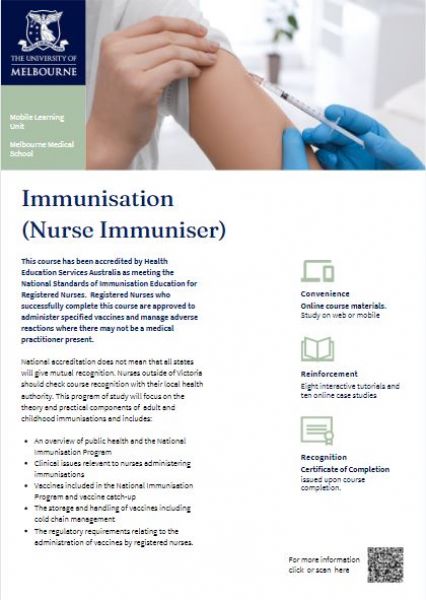
Gain the knowledge required to administer vaccines autonomously (subject to local legislation). The course is recognised in all states in Australia. Online, self-paced.
-
Degrees
Our degrees, taught by our world-renowned academics are the perfect way to begin in the field of biomedical sciences.
-
Short Courses
Our short courses are designed to keep you up to date with the latest research and information.
-
Scholarships
The University and the Faculty of Medicine, Dentistry and Health Sciences offer an extensive range of scholarships and bursaries to undergraduate and postgraduate coursework students and students applying for graduate research study.
-
Current Student Resources
Further information for all students in the Melbourne Medical School, including Doctor of Medicine students, plus links to University student resources.
-
VicREN
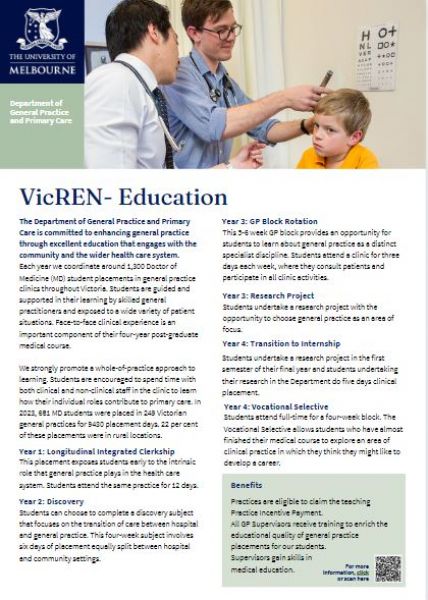
Practice-based research and education networks, such as VicREN, enable collaborations between community-based health care practices, community members and academic institutions.
-
Academic Registrar Posts
The Academic Registrar program supports general practice registrars learn academic skills through individualised learning plans supervised by senior primary care academic leaders.
-
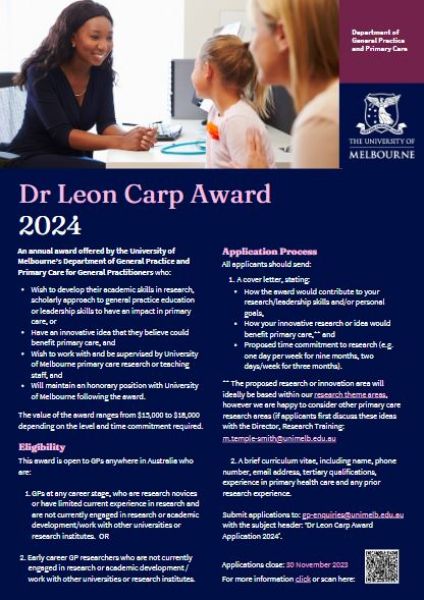
Dr Leon Carp Award
An annual award offered to general practitioners interested in undertaking research to advance the practice of primary care through innovation and improve health outcomes for patients in Australia.
-
GR-Connect
Connecting past, current and future graduate research students in general practice and primary care through networking events, newsletters and mentorship.
Our Podcasts and Webinars
Explore our range of informative webinars and podcasts.
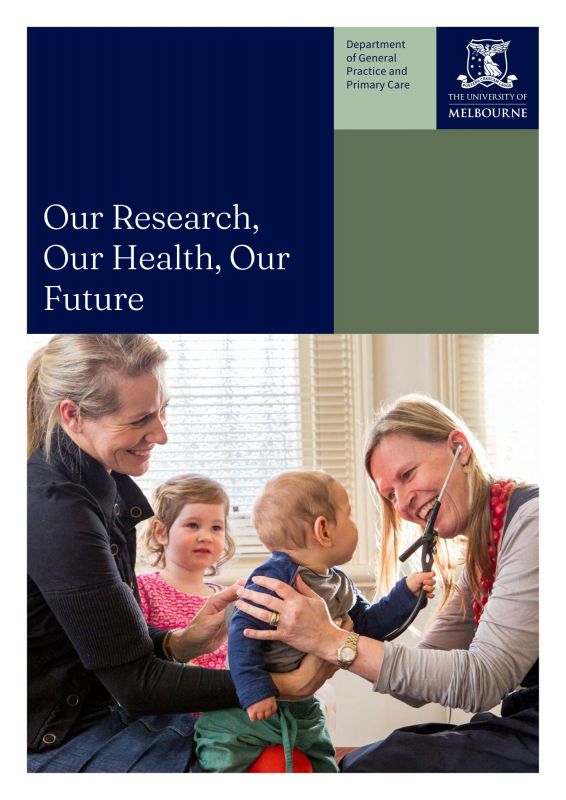
The Book | Department of General Practice and Primary Care
THE PURPOSE OF THIS REPORT
The Department of General Practice and Primary Care works passionately to conduct and promote primary care-based research and medical education in Australia. This report is a celebration not only of the tireless work of current and former staff and students at the Department, but also of the general practices and others who strive to strengthen our primary care system by partnering on robust research and outstanding medical education. The Department of General Practice and Primary Care is indebted to the thousands of general practitioners, nurses, practices managers, allied health staff and patients who have contributed their time and expertise to research and medical education programs.
2024 slide deck
Learn more about our department and how we work to maximise research impact by advancing general practice and primary care through our research and education programs.
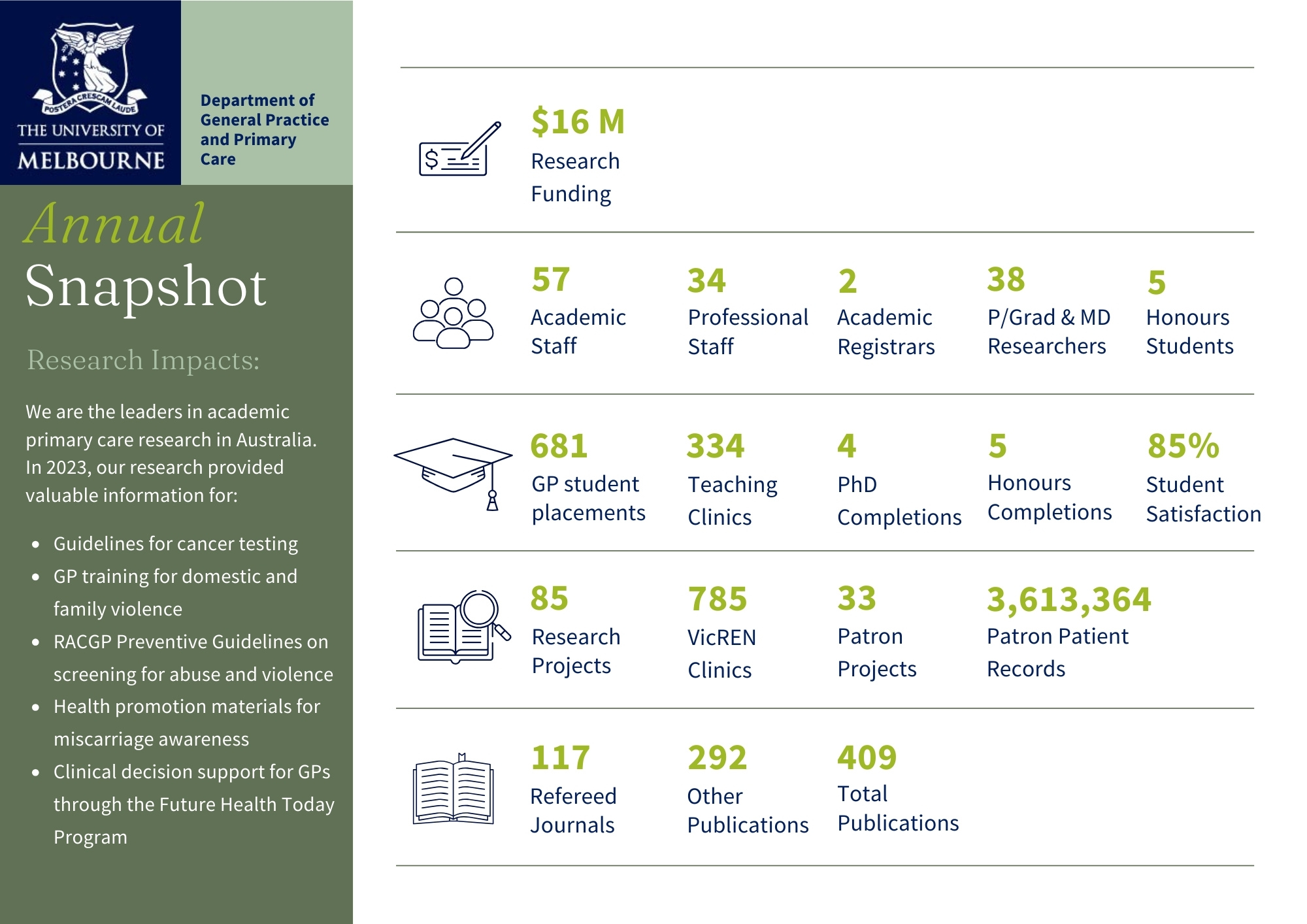
Annual Snapshot
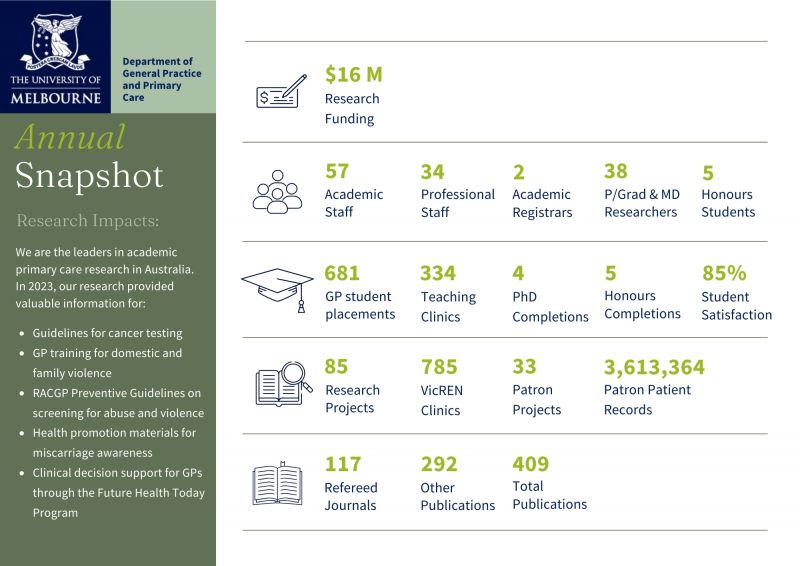
Have a look at our new Annual Snapshot to get a quick overview of the Department's accomplishments for 2023.

Impact Stories | Victorian Research And Education Network
Practice-based research networks (PBRNs) are collaborations between clinical practitioners and academics that undertake and participate in general practice research and work together to assist the translation of new knowledge into practice. PBRNs engage general practitioners as well as practice managers and nurses in the research process, increasing the relevance of the research questions, improving study design and maximising health outcomes for patients.
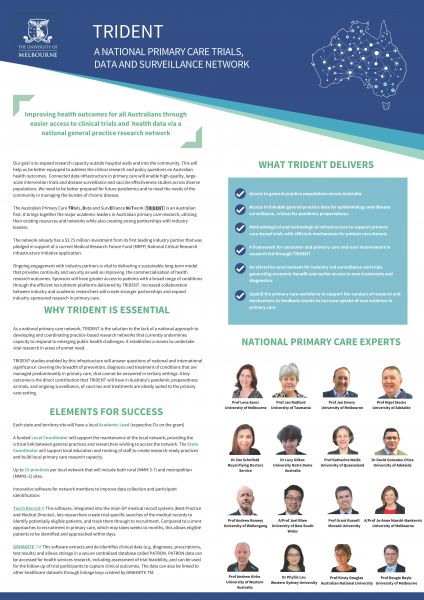
To unite these networks, the Department of General Practice and Primary Care at The University of Melbourne is bringing together the major academic leaders in Australian primary care research and industry leaders in a national PBRN consortium called TRIDENT.
This portfolio includes a small sample of real-world health impacts that have been achieved with the University of Melbourne's general practice-based research network in Victoria, VicREN. This model could be scaled nationally, through TRIDENT.
DiSS Breakfast Club
The Doctors in Secondary School (DiSS) Clinical Training and Support Program hosts a fortnightly Breakfast Club for health professionals. DiSS Breakfast Club is held in an ECHO format on Wednesdays fortnightly each term, 7.30 am-8.30 am (AEDT).
Project ECHO is a virtual knowledge-sharing model that expands the capacity of any professional. It’s about partnerships that bridge gaps to bring change. People worldwide use ECHO to break down silos, collaborate on solutions, and upskill workers.
The panel and participants learn and share together through facilitated discussions. Our inclusive and interactive approach informs every ECHO network and session. ECHO is an interactive conversational community of practice, links like-minded learners.
Breakfast Club can support GPs and nurses working in the DiSS program and aims to address barriers raised by GPs including limited training or resources, not feeling confident, or finding behavioural and health conditions difficult to manage without support.
Interested in attending the Breakfast Club?
Maybe you would like to attend the Youth AOD Project ECHO sessions with St Vincent's Hospital?
Short on time? Click the button below to access previously recorded sessions